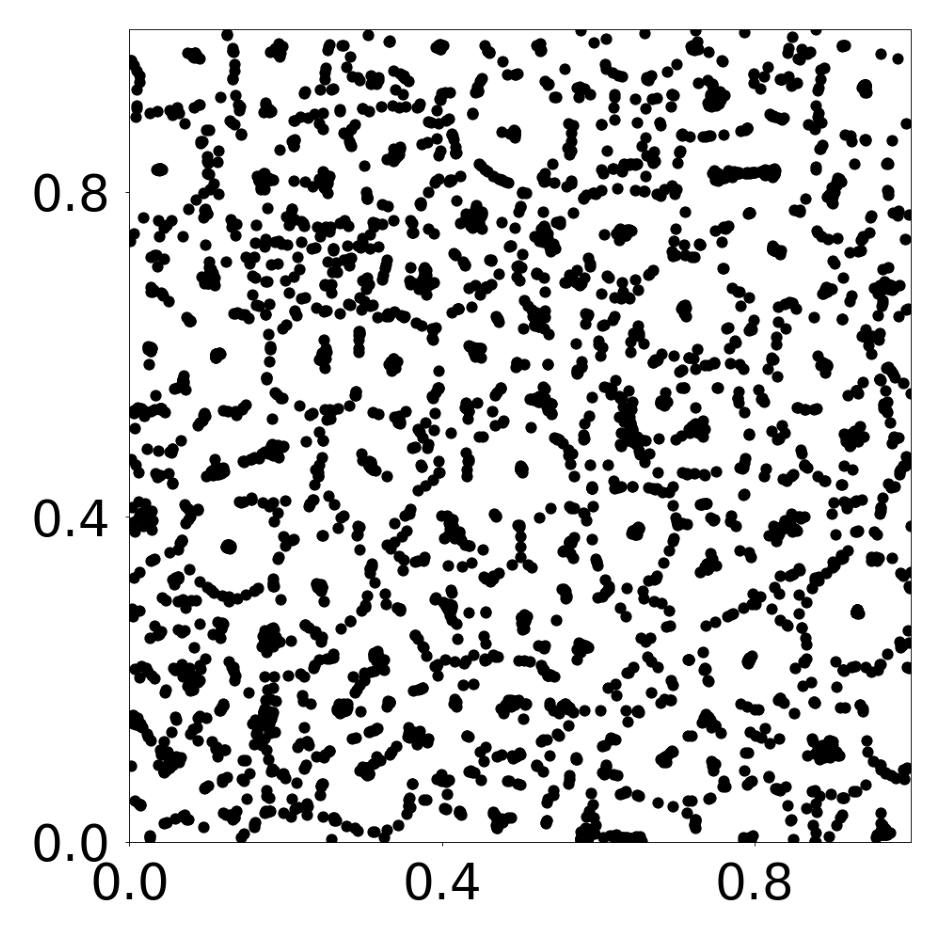
config_file = 'arbitrary_3_continuous'
figure_id = '3_3'
config = ParticleGraphConfig.from_yaml(f'./config/{config_file}.yaml')
device = set_device("auto")Training GNN on attraction-repulsion (continuous function domain)
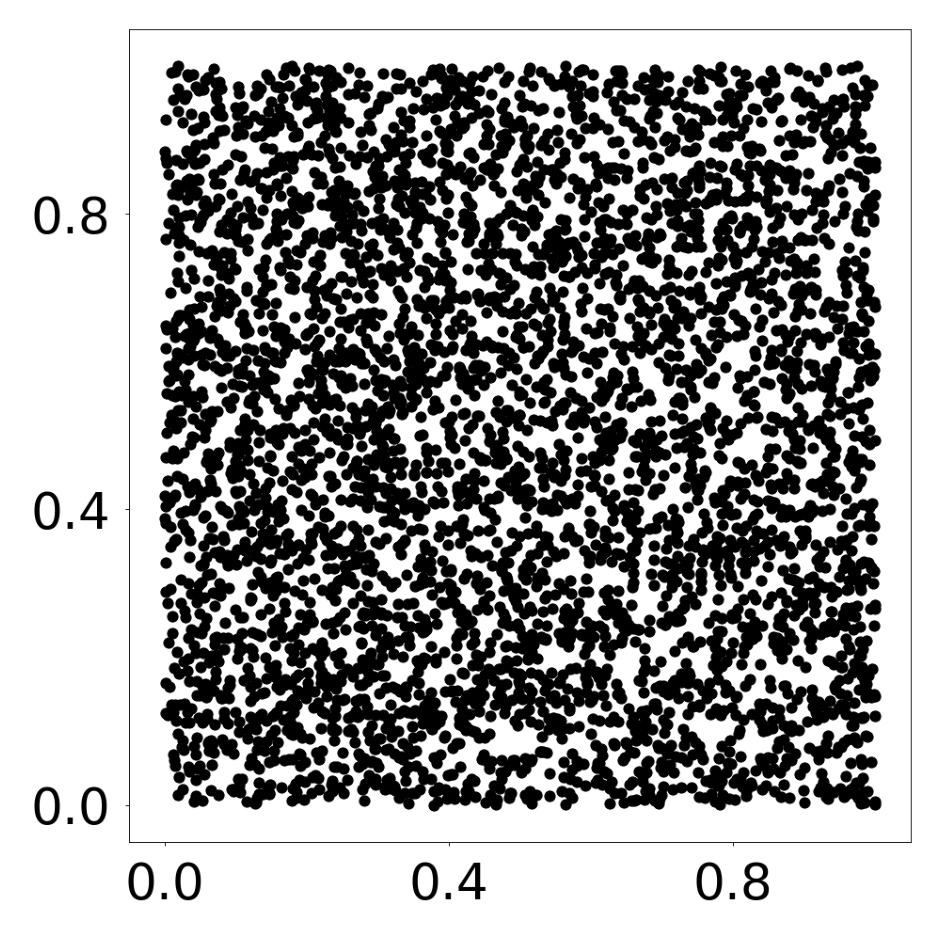
Particles
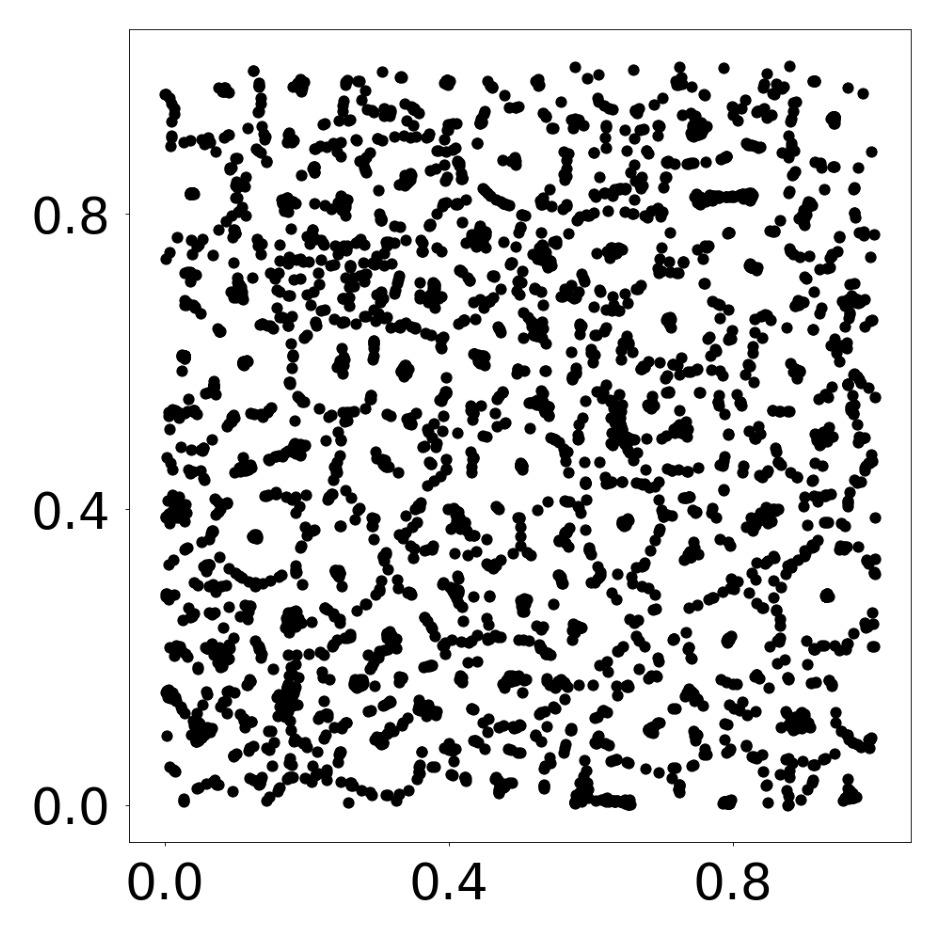
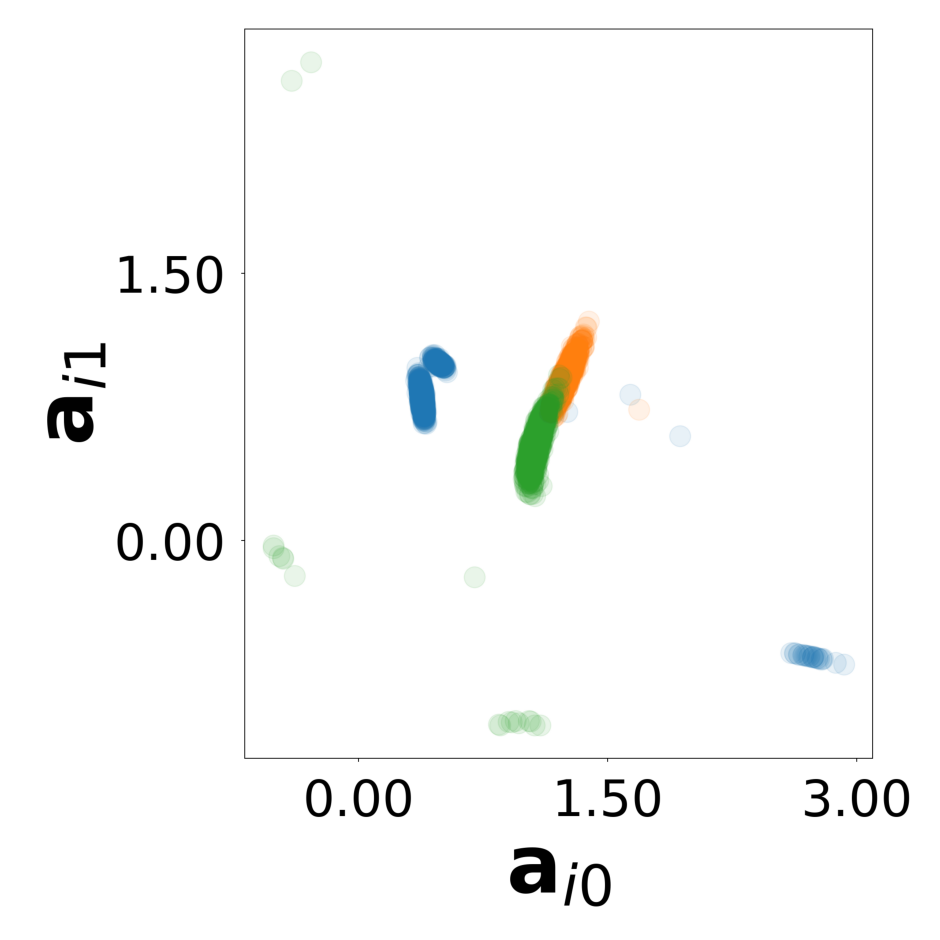
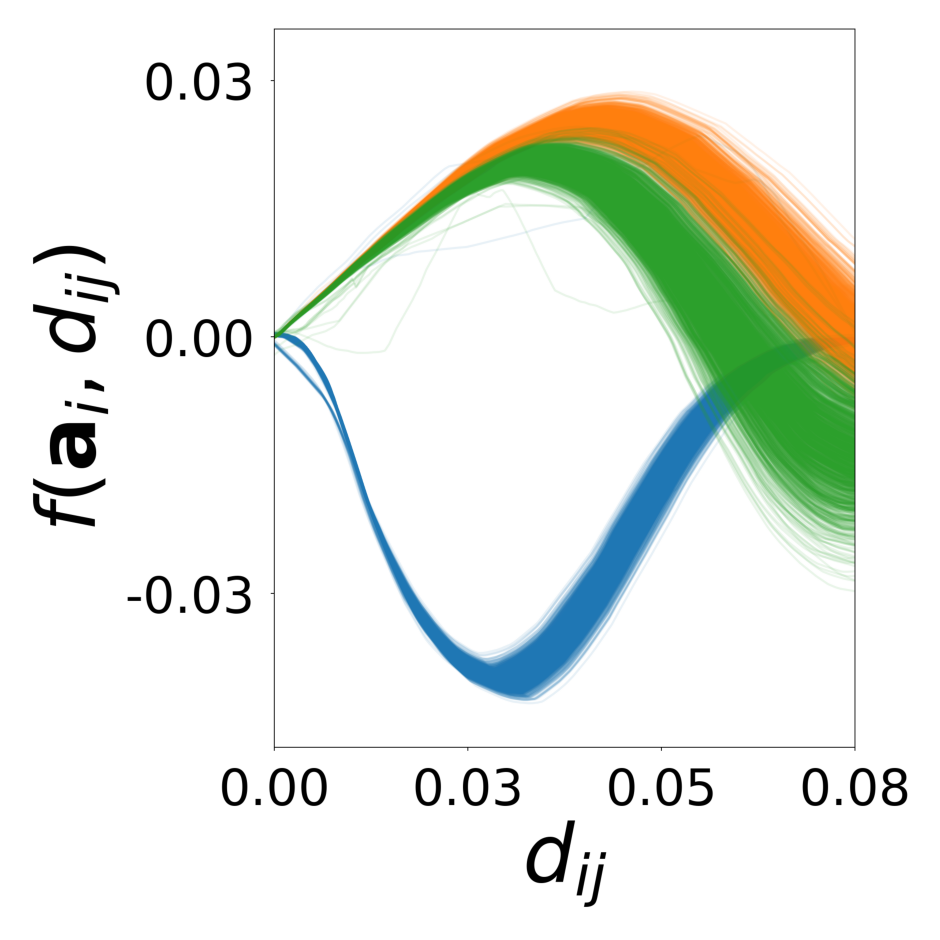
GNN Training
This script creates the third column of paper’s Figure 3. A GNN learns the motion rules of an attraction-repulsion system. The simulation used to train the GNN consists of 4800 particles of many different types. The particles interact with each other according to many different attraction-repulsion laws.
First, we load the configuration file and set the device.
The following model is used to simulate the attraction-repulsion system with PyTorch Geometric.
class AttractionRepulsionModel(pyg.nn.MessagePassing):
    """
    Compute the speed of particles as a function of their relative position according to an attraction-repulsion law.
    The latter is defined by four parameters p = (p1, p2, p3, p4) and a parameter sigma.

    See https://github.com/gpeyre/numerical-tours/blob/master/python/ml_10_particle_system.ipynb
    """

    def __init__(self, p, sigma, bc_dpos, dimension=2):
        super(AttractionRepulsionModel, self).__init__(aggr='mean')

        self.p = p
        self.sigma = sigma
        self.bc_dpos = bc_dpos
        self.dimension = dimension

    def forward(self, data: Data):
        x, edge_index = data.x, data.edge_index

        edge_index, _ = pyg_utils.remove_self_loops(edge_index)
        particle_type = to_numpy(x[:, 1 + 2 * self.dimension])
        parameters = self.p[particle_type,:]
        d_pos = self.propagate(edge_index, pos=x[:, 1:self.dimension + 1], parameters=parameters)
        return d_pos

    def message(self, pos_i, pos_j, parameters_i):

        relative_position = self.bc_dpos(pos_j - pos_i)
        distance_squared = torch.sum(relative_position ** 2, dim=1)  # squared distance
        f = (parameters_i[:, 0] * torch.exp(-distance_squared ** parameters_i[:, 1] / (2 * self.sigma ** 2))
             - parameters_i[:, 2] * torch.exp(-distance_squared ** parameters_i[:, 3] / (2 * self.sigma ** 2)))
        velocity = f[:, None] * relative_position

        return velocity


def bc_pos(x):
    return torch.remainder(x, 1.0)


def bc_dpos(x):
    return torch.remainder(x - 0.5, 1.0) - 0.5
The training data is generated with the above Pytorch Geometric model
p = torch.squeeze(torch.tensor(config.simulation.params))
sigma = config.simulation.sigma
model = AttractionRepulsionModel(
    p=p,
    sigma=sigma,
    bc_dpos=bc_dpos,
    dimension=config.simulation.dimension
)

generate_kwargs = dict(device=device, visualize=True, run_vizualized=0, style='color', alpha=1, erase=True, save=True, step=10)
train_kwargs = dict(device=device, erase=True)
test_kwargs = dict(device=device, visualize=True, style='color', verbose=False, best_model='20', run=0, step=1, save_velocity=True)

data_generate_particles(config, model, bc_pos, bc_dpos, **generate_kwargs)
The GNN model (see src/ParticleGraph/models/Interaction_Particle.py) is trained and tested.
Since we ship the trained model with the repository, this step can be skipped if desired.
if not os.path.exists(f'log/try_{config_file}'):
    data_train(config, config_file, **train_kwargs)
The model that has been trained in the previous step is used to generate the rollouts. The rollout visualization can be found in paper_experiments/log/try_arbitrary_3_continuous/tmp_recons.
data_test(config, config_file, **test_kwargs)Finally, we generate the figures that are shown in Figure 3.
config_list, epoch_list = get_figures(figure_id, device=device)