config_file = 'wave_slit'
config = ParticleGraphConfig.from_yaml(f'./config/{config_file}.yaml')
device = set_device("auto")Wave propagation with different diffusion coefficients
Mesh
Simulation
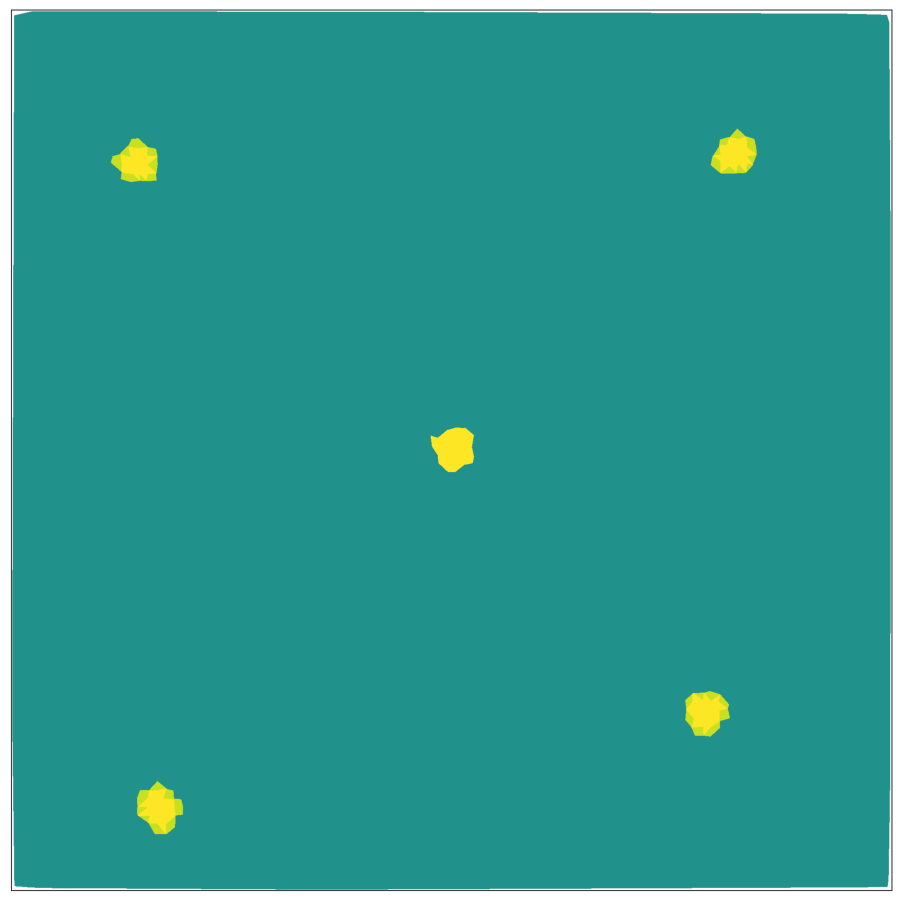
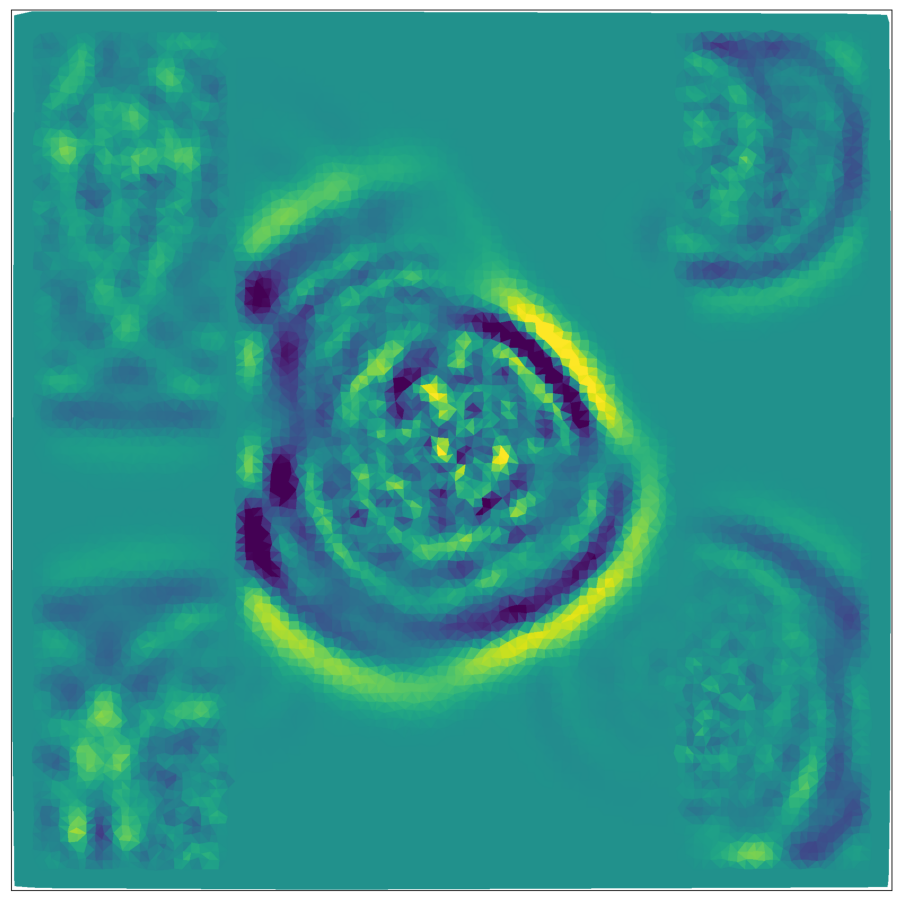
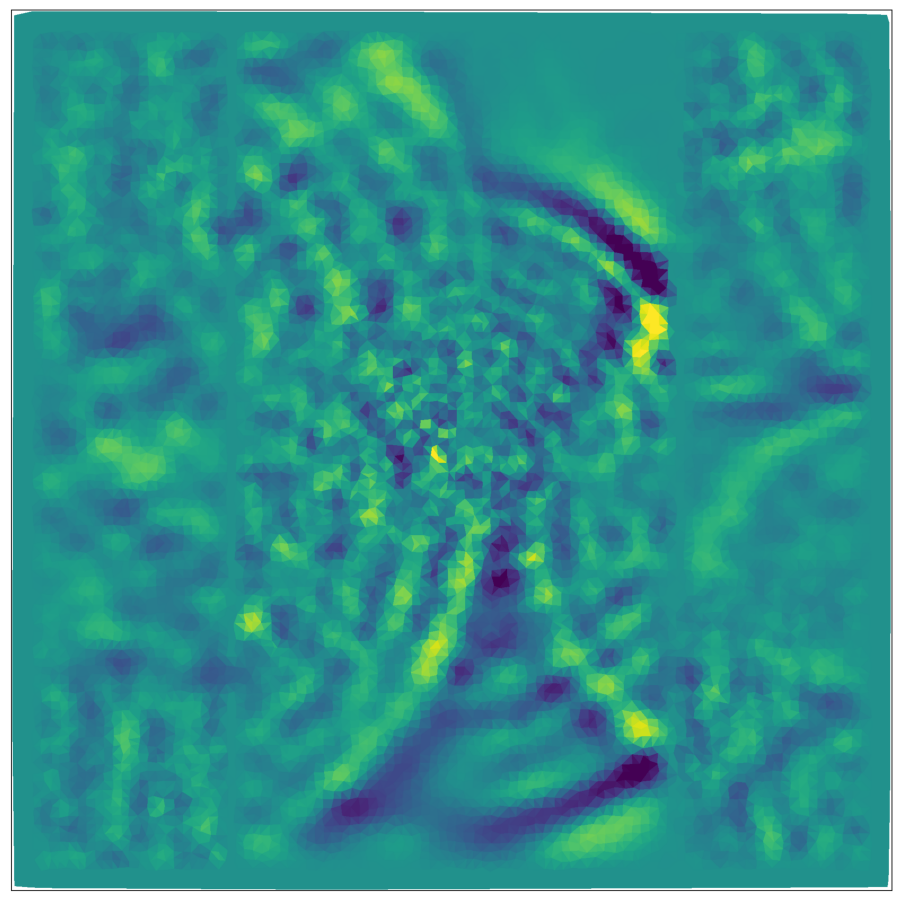
This script creates the fifth column of paper’s Figure 2. Simulation of wave-propagation over a mesh of 1E4 nodes with variable propagation-coefficients.
First, we load the configuration file and set the device.
The following model is used to simulate the wave propagation with PyTorch Geometric.
class WaveModel(pyg.nn.MessagePassing):
    """Interaction Network as proposed in this paper:
    https://proceedings.neurips.cc/paper/2016/hash/3147da8ab4a0437c15ef51a5cc7f2dc4-Abstract.html"""

    """
    Compute the Laplacian of a scalar field.

    Inputs
    ----------
    data : a torch_geometric.data object
    note the Laplacian coeeficients are in data.edge_attr

    Returns
    -------
    laplacian : float
        the Laplacian
    """

    def __init__(self, aggr_type=[], beta=[], bc_dpos=[], coeff=[]):
        super(WaveModel, self).__init__(aggr='add')  # "mean" aggregation.

        self.beta = beta
        self.bc_dpos = bc_dpos
        self.coeff = coeff

    def forward(self, data):
        x, edge_index, edge_attr = data.x, data.edge_index, data.edge_attr

        c = self.coeff
        u = x[:, 6:7]

        laplacian_u = self.propagate(edge_index, u=u, edge_attr=edge_attr)
        dd_u = self.beta * c * laplacian_u

        self.laplacian_u = laplacian_u

        return dd_u

    def message(self, u_j, edge_attr):
        L = edge_attr[:,None] * u_j

        return L

def bc_pos(x):
    return torch.remainder(x, 1.0)

def bc_dpos(x):
    return torch.remainder(x - 0.5, 1.0) - 0.5
The data is generated with the above Pytorch Geometric model. Note two datasets are generated, one for training and one for validation. If the simulation is too large, you can decrease n_particles (multiple of 5) and n_nodes in “wave_slit.yaml”
model = WaveModel(aggr_type=config.graph_model.aggr_type, beta=config.simulation.beta)

generate_kwargs = dict(device=device, visualize=True, run_vizualized=0, style='color', erase=False, save=True, step=20)
train_kwargs = dict(device=device, erase=True)
test_kwargs = dict(device=device, visualize=True, style='color', verbose=False, best_model='20', run=0, step=1, save_velocity=True)

data_generate_mesh(config, model , **generate_kwargs)
Finally, we generate the figures that are shown in Figure 2. All frames are saved in ‘decomp-gnn/paper_experiments/graphs_data/graphs_wave_slit/Fig/’.