config_file = 'gravity_16'
config = ParticleGraphConfig.from_yaml(f'./config/{config_file}.yaml')
device = set_device("auto")Gravity-like system with different particle masses
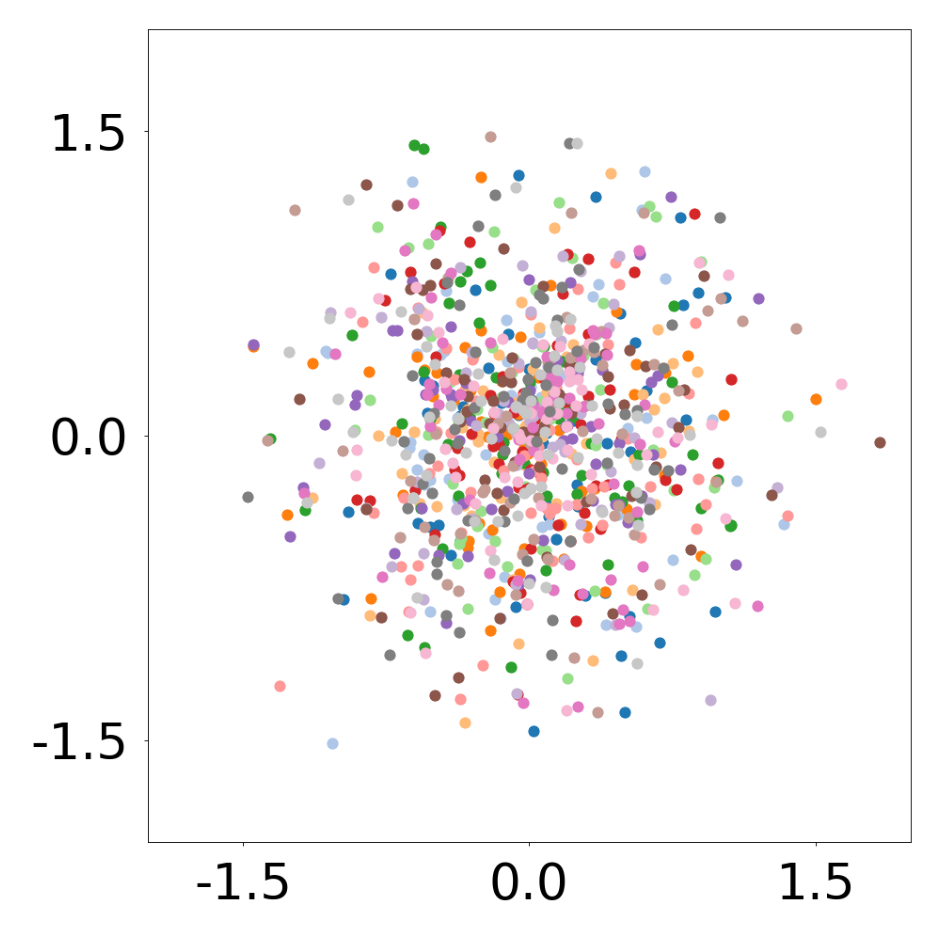
Particles
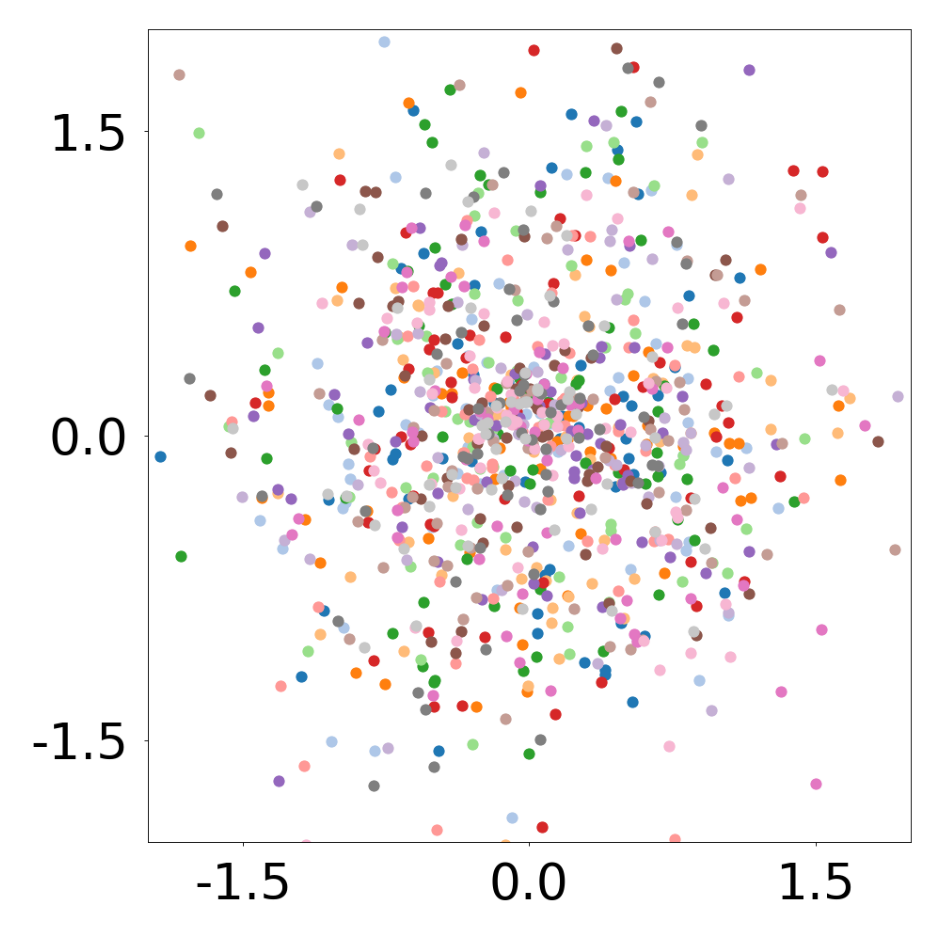
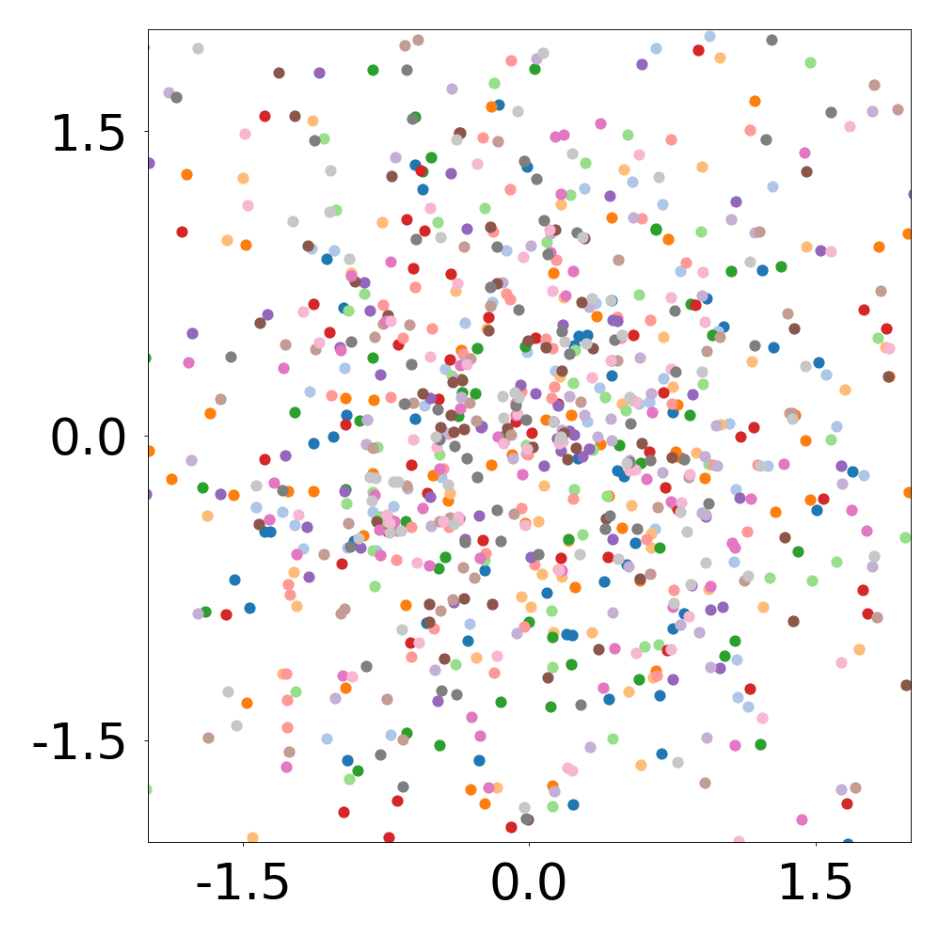
Simulation
This script creates the second column of paper’s Figure 2. Simulation of a gravity-like system, 960 particles, 16 different masses.
First, we load the configuration file and set the device.
The following model is used to simulate the gravity-like system with PyTorch Geometric.
class GravityModel(pyg.nn.MessagePassing):
    """Interaction Network as proposed in this paper:
    https://proceedings.neurips.cc/paper/2016/hash/3147da8ab4a0437c15ef51a5cc7f2dc4-Abstract.html"""

    """
    Compute the acceleration of particles as a function of their relative position according to the gravity law.

    Inputs
    ----------
    data : a torch_geometric.data object

    Returns
    -------
    pred : float
        the acceleration of the particles (dimension 2)
    """

    def __init__(self, aggr_type=[], p=[], clamp=[], pred_limit=[], bc_dpos=[]):
        super(GravityModel, self).__init__(aggr='add')  # "mean" aggregation.

        self.p = p
        self.clamp = clamp
        self.pred_limit = pred_limit
        self.bc_dpos = bc_dpos

    def forward(self, data):
        x, edge_index = data.x, data.edge_index
        edge_index, _ = pyg_utils.remove_self_loops(edge_index)
        particle_type = to_numpy(x[:, 5])

        mass = self.p[particle_type]
        dd_pos = self.propagate(edge_index, pos=x[:, 1:3], mass=mass[:, None])
        return dd_pos

    def message(self, pos_i, pos_j, mass_j):
        distance_ij = torch.sqrt(torch.sum(self.bc_dpos(pos_j - pos_i) ** 2, axis=1))
        distance_ij = torch.clamp(distance_ij, min=self.clamp)
        direction_ij = self.bc_dpos(pos_j - pos_i) / distance_ij[:, None]
        dd_pos = mass_j * direction_ij / (distance_ij[:, None] ** 2)

        return torch.clamp(dd_pos, max=self.pred_limit)


def bc_pos(x):
    return torch.remainder(x, 1.0)


def bc_dpos(x):
    return torch.remainder(x - 0.5, 1.0) - 0.5
The data is generated with the above Pytorch Geometric model. Note two datasets are generated, one for training and one for validation. If the simulation is too large, you can decrease n_particles (multiple of 16) in “gravity_16.yaml”.
p = torch.squeeze(torch.tensor(config.simulation.params))
model = GravityModel(aggr_type=config.graph_model.aggr_type, p=torch.squeeze(p), clamp=config.training.clamp,
              pred_limit=config.training.pred_limit, bc_dpos=bc_dpos)

generate_kwargs = dict(device=device, visualize=True, run_vizualized=0, style='color', alpha=1, erase=True, save=True, step=10)
train_kwargs = dict(device=device, erase=True)
test_kwargs = dict(device=device, visualize=True, style='color', verbose=False, best_model='20', run=0, step=1, save_velocity=True)

data_generate_particles(config, model, bc_pos, bc_dpos, **generate_kwargs)
Finally, we generate the figures shown in Figure 2. All frames are saved in ‘decomp-gnn/paper_experiments/graphs_data/gravity_16/Fig/’.