Supplementary Figure 10: effect of Gaussian noise

Neural Activity
Simulation
GNN Training
Noise
Author

Cédric Allier, Stephan Saalfeld

This script reproduces the panels of paper’s Supplementary Figure 10. Gaussian noise is injected into the simulated dynamics (SNR of ∼10 dB).

Simulation parameters:

The simulation follows Equation 2 from the paper:

\[\frac{dx_i}{dt} = -\frac{x_i}{\tau_i} + s_i \cdot \tanh(x_i) + g_i \cdot \sum_j W_{ij} \cdot \tanh(x_j) + \eta_i(t)\]

Configuration and Setup

Code
print()
print("=" * 80)
print("Supplementary Figure 10: 1000 neurons, 4 types, dense connectivity, Gaussian noise")
print("=" * 80)

device = []
best_model = ''
config_file_ = 'signal_fig_supp_10'

print()
config_root = "./config"
config_file, pre_folder = add_pre_folder(config_file_)

# load config
config = NeuralGraphConfig.from_yaml(f"{config_root}/{config_file}.yaml")
config.config_file = config_file
config.dataset = config_file

if device == []:
    device = set_device(config.training.device)

log_dir = f'./log/{config_file}'
graphs_dir = f'./graphs_data/{config_file}'

Step 1: Generate Data

Generate synthetic neural activity data with Gaussian noise using the PDE_N2 model. This creates the training dataset with 1000 neurons of 4 different types over 100,000 time points.

Outputs:

  • Supp. Fig 10b: Activity time series used for GNN training
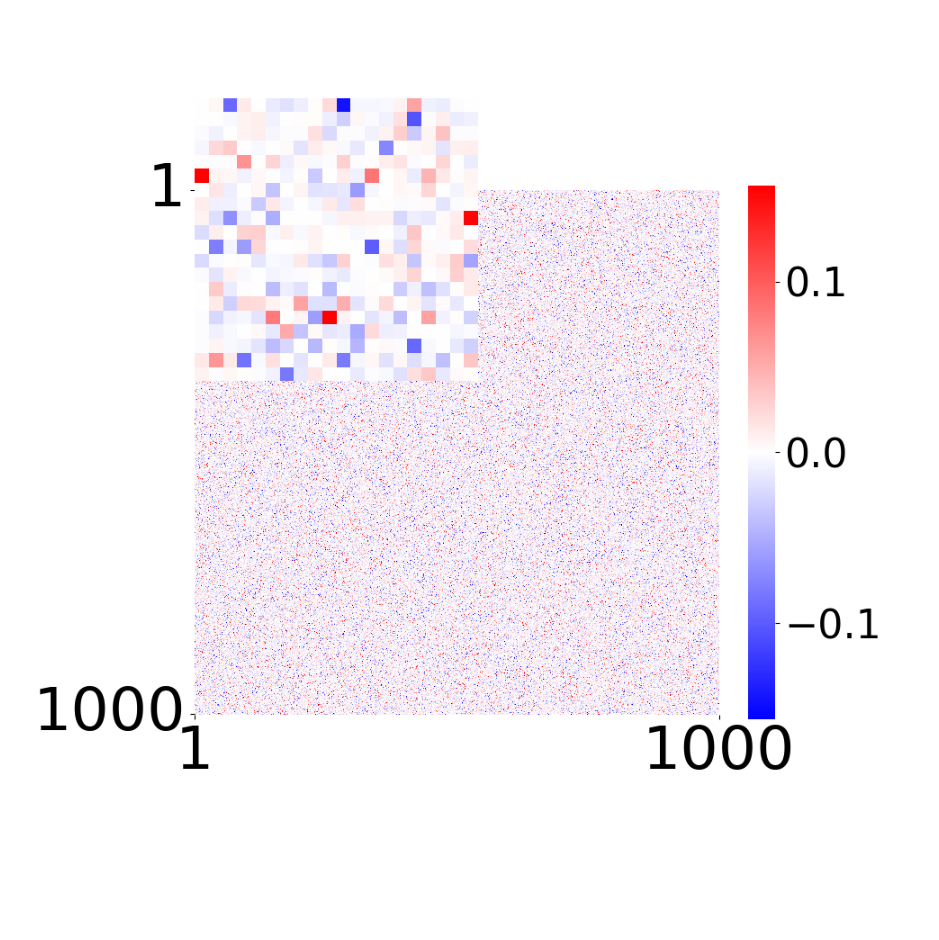
  • Supp. Fig 10c: True connectivity matrix \(W_{ij}\)
Code
# STEP 1: GENERATE
print()
print("-" * 80)
print("STEP 1: GENERATE - Simulating neural activity with Gaussian noise")
print("-" * 80)

# Check if data already exists
data_file = f'{graphs_dir}/x_list_0.npy'
if os.path.exists(data_file):
    print(f"data already exists at {graphs_dir}/")
    print("skipping simulation, regenerating figures...")
    data_generate(
        config,
        device=device,
        visualize=False,
        run_vizualized=0,
        style="color",
        alpha=1,
        erase=False,
        bSave=True,
        step=2,
        regenerate_plots_only=True,
    )
else:
    print(f"simulating {config.simulation.n_neurons} neurons, {config.simulation.n_neuron_types} types")
    print(f"generating {config.simulation.n_frames} time frames with Gaussian noise")
    print(f"output: {graphs_dir}/")
    print()
    data_generate(
        config,
        device=device,
        visualize=False,
        run_vizualized=0,
        style="color",
        alpha=1,
        erase=False,
        bSave=True,
        step=2,
    )

Supp. Fig 10b: Sample of 100 time series taken from the activity data with Gaussian noise (~10 dB SNR).

Supp. Fig 10c: True connectivity \(W_{ij}\). The inset shows 20×20 weights.

Step 2: Train GNN

Train the GNN to learn connectivity \(W\), latent embeddings \(\mathbf{a}_i\), and functions \(\phi^*, \psi^*\). The GNN learns to predict \(dx_i/dt\) from the noisy observed activity \(x_i\).

The GNN optimizes the update rule (Equation 3 from the paper):

\[\hat{\dot{x}}_i = \phi^*(\mathbf{a}_i, x_i) + \sum_j W_{ij} \psi^*(x_j)\]

where \(\phi^*\) and \(\psi^*\) are MLPs (ReLU, hidden dim=64, 3 layers). \(\mathbf{a}_i\) is a learnable 2D latent vector per neuron, and \(W\) is the learnable connectivity matrix.

Code
# STEP 2: TRAIN
print()
print("-" * 80)
print("STEP 2: TRAIN - Training GNN to learn W, embeddings, phi, psi from noisy data")
print("-" * 80)

# Check if trained model already exists (any .pt file in models folder)
import glob
model_files = glob.glob(f'{log_dir}/models/*.pt')
if model_files:
    print(f"trained model already exists at {log_dir}/models/")
    print("skipping training (delete models folder to retrain)")
else:
    print(f"training for {config.training.n_epochs} epochs, {config.training.n_runs} run(s)")
    print(f"learning: connectivity W, latent vectors a_i, functions phi* and psi*")
    print(f"models: {log_dir}/models/")
    print(f"training plots: {log_dir}/tmp_training")
    print(f"tensorboard: tensorboard --logdir {log_dir}/")
    print()
    data_train(
        config=config,
        erase=False,
        best_model=best_model,
        style='color',
        device=device
    )

Step 3: GNN Evaluation

Figures matching Supplementary Figure 10 from the paper.

Figure panels:

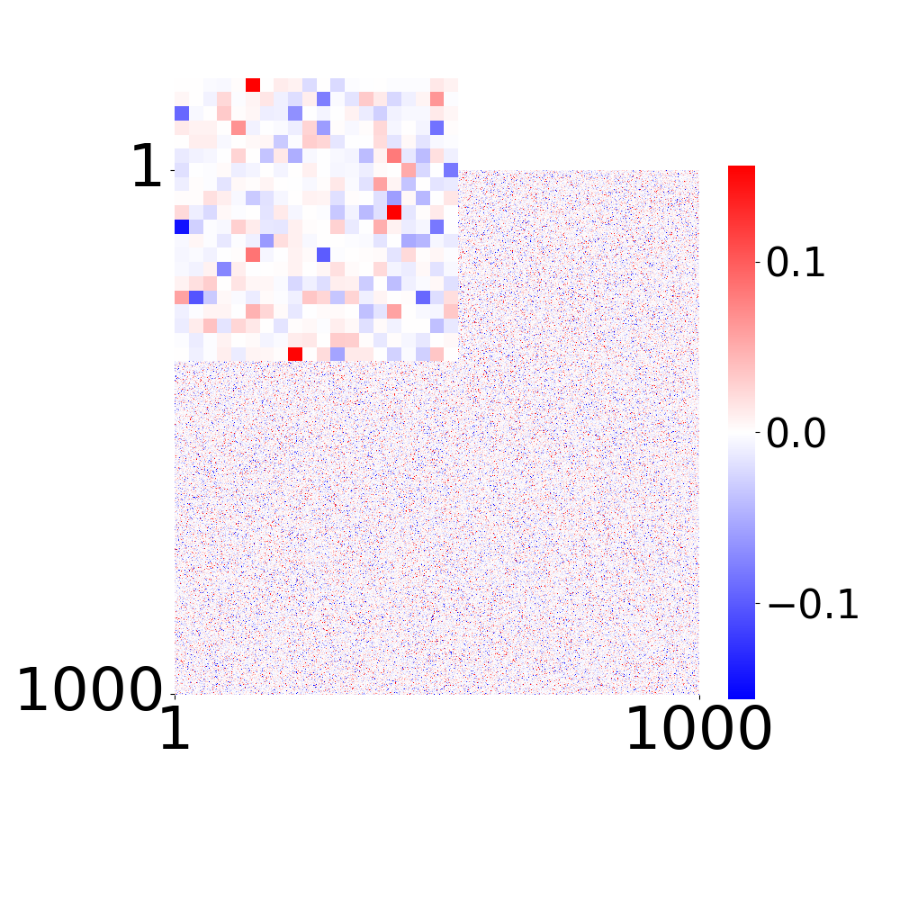
  • Supp. Fig 10d: Learned connectivity matrix
  • Supp. Fig 10e: Comparison of learned vs true connectivity
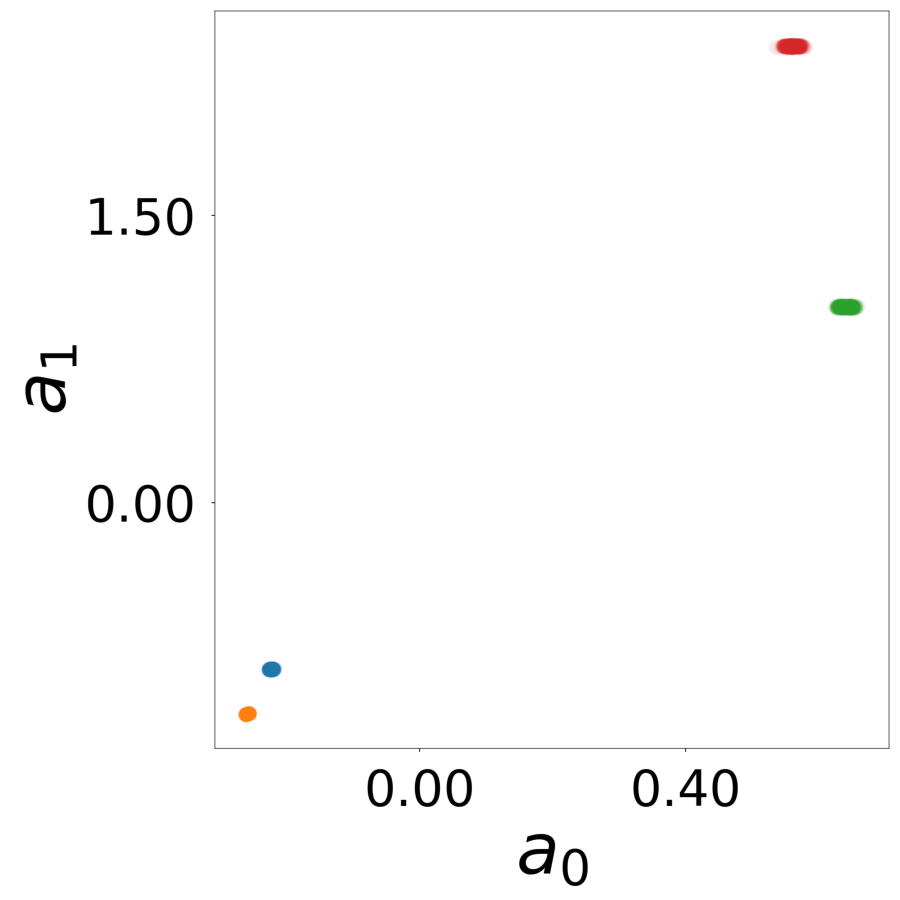
  • Supp. Fig 10f: Learned latent vectors \(\mathbf{a}_i\)
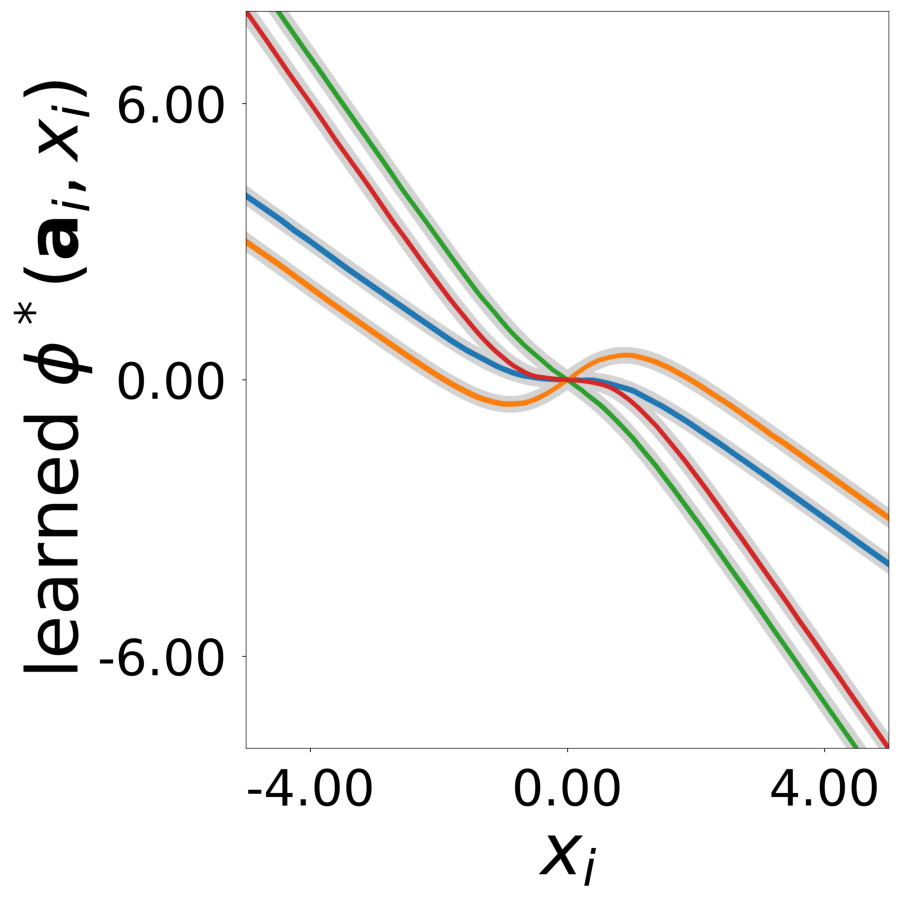
  • Supp. Fig 10g: Learned update functions \(\phi^*(\mathbf{a}_i, x)\)
  • Supp. Fig 10h: Learned transfer function \(\psi^*(x)\)
Code
# STEP 3: GNN EVALUATION
print()
print("-" * 80)
print("STEP 3: GNN EVALUATION - Generating Supplementary Figure 10 panels (d-h)")
print("-" * 80)
print(f"panel (d): Learned connectivity matrix")
print(f"panel (e): W learned vs true (R^2, slope)")
print(f"panel (f): Latent vectors a_i (4 clusters)")
print(f"panel (g): Update functions phi*(a_i, x)")
print(f"panel (h): Transfer function psi*(x)")
print(f"output: {log_dir}/results/")
print()
folder_name = './log/' + pre_folder + '/tmp_results/'
os.makedirs(folder_name, exist_ok=True)
data_plot(config=config, config_file=config_file, epoch_list=['best'], style='color', extended='plots', device=device, apply_weight_correction=True, plot_eigen_analysis=False)

Supplementary Figure 10: GNN Evaluation Results

Supp. Fig 10d: Learned connectivity.

Supp. Fig 10e: Comparison of learned and true connectivity (given \(g_i\)=10).

Supp. Fig 10f: Learned latent vectors \(a_i\) of all neurons.

Supp. Fig 10g: Learned update functions \(\phi^*(a_i, x)\). The plot shows 1000 overlaid curves, one for each vector \(a_i\). Colors indicate true neuron types. True functions are overlaid in light gray.

Supp. Fig 10h: Learned transfer function \(\psi^*(x)\), normalized to a maximum value of 1. True function is overlaid in light gray.